Showing posts with label News. Show all posts

Jul 31, 2010

Phu Quy Island


120 kilometers southeast of the Phan Thiet Sea, lies ten beautiful islands which comprises the known Phu Quy District. From the range of islets, Phu Quy Island is deemed the largest with 16.5 km2 in area and a population of about 25,000. With its long stretch of white sandy beaches and dense coral reefs, only the rocky, northern half of the island is inhabited. Endowed with beautiful landscapes which include vast rows or casuarinas trees, the entirety of the island is very pristine.

Con Dao Islands

The Con Dao Islands are an emerald archipelago situated in the South China Sea about 50 kilometers off the south-eastern coast of Vietnam, including 16 islands and islets. Con Dao is around 185 kilometers away from the town Vung Tau. The largest island is Con Son Island, famous for its prison built by the French colonial government and giving Con Dao the name Devil’s Island, for nobody was supposed to ever return after embarking a boat heading for the island. The remains of these buildings can be visited today.

Phu Quoc Island

The tear-shaped Phu Quoc (Vietnamese Phú Quốc) is part of the Kiên Giang province. The distance from Phú Quốc to mainland Viet Nam is 45 km to Hà Tiên and 120 km to Rạch Giá. The island is 50 km long (from north to south) and 25 km wide (from east to west at its widest part).

Surrounded by more than 40 km of white beaches decorated with coconut palms, Phú Quốc, situated in the Gulf of Thailand near the Cambodian border, is Vietnam’s largest island. Its western coastline is sparsely populated while the interior is largely covered with jungle and mainly deserted.

Jul 26, 2010

Discovering the mysteries inside Tham Nam Caves

Tham Nam Caves have wowed visitors who make the journey with its magnificent features and stunning sights.

The caves are located inside Pha Chang Limestone Mountain by Nam Non River, Huu Khuong Commune, Tuong Duong District, Nghe An Province.

Tham Nam’s caves cover thousands of square metres and are filled with unique stalactites and stalagmites in various shapes. How they look can vary depending on the imagination of visitors.

Discovering the mysteries of these caves followed by enjoying fish caught fresh from the river that runs through it, is a delightful experience for those who visit Tham Nam.

Central Vietnam drawing domestic travellers

Central Vietnam has seen a tourist boom this year, welcoming 30-40% more tourists than last year. According to tourism companies in Da Nang, most of these tourists are domestic, coming from cities such as Hanoi and Ho Chi Minh.

Da Nang Beach: an attractive destination for tourists.
Cao Tri Dung, Deputy General Director of Vitours Company said, “This summer, we’re seeing an extremely high number of tourists booking with us. From accommodation to plane trips, coaches to tour guides, the booking for these services is overwhelming, and we haven’t been able to meet the demand. It’s going to be this hectic at least until August 15.”

Viet Da Travel Company has experienced the same situation. Dinh Van Loc, Director of the company, said that their company has also been overbooked. The company has been unable to find any 30 - 45 seat coaches over the past week, and rooms at luxury hotels have all been fully booked, Loc said.

In response to why there is a sudden increase of tourists this summer, Cao Tri Dung said that there are probably many different explanations, but the main reason would lie in the very attraction of the destination. Da Nang is one of the few places that could offer such a diverse variety of activities for tourists, whether they want to go hiking up a mountain or go sunbathing at the beach, and there are many options for hotels as well as restaurants in the area.

Jul 13, 2010

Crystalline waters shine in Ha Long Bay


Last April, I finally had a chance to get a glimpse of the country where my maternal grandfather fought in the Vietnam War. Based on the stories my grandfather told me while I was growing up, I arrived in Vietnam expecting to see evidence of the war. Instead I was surprised to see how modern the country is.

But honestly, the thing that really impressed me was the food, and the bakeries in particular. Although we have bakeries in Korea, the coffee and bread in the bakeries of Vietnam overwhelmed me with their flavours, a mix of tastes and textures from France and Asia, surely a remnant of the country’s colonial past.

I was in Vietnam at the invitation the Vietnamese Foreign Ministry and Asia Europe Foundation to report on an Asia-Europe Meeting workshop that took place from April 28 to 29 in Ha Long Bay in Quang Ninh Province in the northeastern corner of Vietnam. At the workshop, ASEM workshop participants agreed to forge stronger ties through cultural diplomacy linking Asia and Europe.
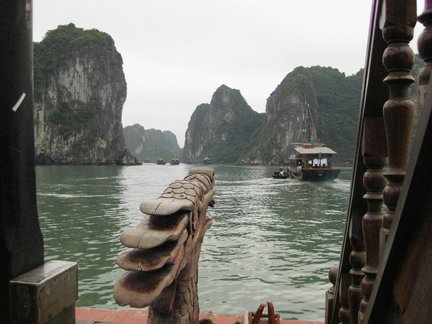
On the last day of the workshop, the Vietnamese Foreign Ministry took us on a cruise of Ha Long Bay, which covers 1,553 square kilometers (600 square miles) and has 1,969 islands. After the 10-minute ride from the Halong Plaza Hotel where we were staying we arrived at the pier and boarded a waiting cruise ship.

The other passengers and I sat down at tables set out on the deck and were treated to a feast that was a mixture of Western and Asian cuisine. Around us, thousands of limestone islets rose out of crystalline emerald waters that glistened in the sun.

Pham Sanh Chau, director general of the department for cultural relations and Unesco under the Ministry of Foreign Affairs of Vietnam, said Ha Long Bay is the first World Heritage Site in Vietnam. Unesco recognized it as a World Heritage Site in 1994 and again in 2000 in recognition of its natural beauty and geological value.

“Ha Long Bay deserves to be named as one of the seven new wonders of nature because it’s like paradise. There is nothing like it anywhere in the world,” Chau said. “It’s not an area just for tourism. It also serves as buffer zone against climate change. It’s rich in marine biodiversity and many scientists say this should be a geological park.”
As we sat back with our plates full of food, fishing boats large and small passed us on their way to their next catch. People exclaimed in excitement when they saw a small tent set up on the waters of Ha Long Bay. The tent, we learned, had been built to accommodate fishermen in need of a break or a place to sleep.

Our trip around the bay was nothing if not idyllic, but our tour guide explained that tourists who visit the area usually take overnight cruises to Ha Long Bay. The cruise starts with lunch aboard the ship and continues with stops at various caves for kayaking and swimming. Guests then sleep on the boat that night.

Because of my tight schedule, I had to return to my hotel that night and wasn’t able to take advantage of what sounded like a lovely diversion, but before I did I took a tour of the boat’s lower deck, where the sleeping rooms are located. The rooms are cozy and designed to accommodate two people. Each one is fully furnished with a bed, sofa, shower booth and toilet, just like in a hotel.

Although my journey to Vietnam was short, I picked up a few tips for my next trip that I’d like to share. First, you don’t have to set an alarm because there is an endless stream of honking motorbikes whizzing by every morning in Hanoi and the noise is enough to force your eyes open. Most Vietnamese people start the day early and most offices open at 7:30 a.m.

Second, you need to be extremely brave when crossing the street. There are no street lights like the ones you find in other major cities. When you try to wade into the traffic that is rushing by, drivers of cars and motorcycles swerve around you without slowing down. On my first day in Hanoi, I stood on the street for 10 minutes waiting for the right time to cross when I finally found a group of Vietnamese women intent on jaywalking.

Third, although the traffic is insane, make sure you stroll around the city on foot. This is the best way to experience a typical day in the life of the Vietnamese people. Women balance poles laden with heavy baskets of vegetables and flowers on their shoulders, passing people who squat on the sidewalk or sit in plastic chairs, sipping tea and eating pho (beef noodle soup) at outdoor food stalls. This is where you can feel the energy of the people.

If you are planning a trip to Vietnam, I recommend you go to Hanoi first, take a tour of Hoan Kiem Lake and the Old Quarter and then take the overnight cruise of Ha Long Bay. There are travel agencies that arrange rides to the bay from Hanoi in the morning, which takes nearly four hours by car. The cruise starts at noon and the price of the overnight cruise starts at $120.

Jul 8, 2010

Much has changed, but much has stayed the same as Hanoi’s famous old quarter weathers the storms of modernity.
Hanoi’s old quarter doesn’t seem so old.

Brand new motorbikes, SUVs and even busses zip by in every direction, shattering ear drums with their horns and pushing stray pedestrians out of the way.
But despite the traffic and modern signage, much of traditional Hanoi is the same as it was before the motorbikes and SUVs.
Peek through or above the thick black electric cables blocking your view overhead and you’ll see the colorful, if not fading, facades of old Chinese shophouses, French villas and Buddhist pagodas and temples.
Elderly couples sit and drink tea on their stoops, youngsters smoke cigarettes on balconies adorned with decorative iron work and trellises filled with tropical plants.
But each residence is also a business, turning the entire quarter into a giant market. Down the tiny streets and seemingly endless labyrinth of alleys, shopkeepers sell everything under the sun, from ball bearings and light bulbs to live chickens and snake wine. The clutter of open air fish markets, the noise of squealing pigs and the loud screeches and bangs from the metal workshops make this site unlike any in the world.
But the history of the area is shrouded in mystery, like the low fog that hangs over Hoan Kiem Lake on early winter mornings.
Many Vietnamese and foreigners know the area as the “36 streets” which is a misnomer, as the quarter has far more than 36 streets, and no one is certain where that number even came from.
Some researchers say the oldest part of Hanoi was originally based off of 36 streets, each of which sold a different ware. Others contend that the number 36 came from the 15th century, when workers of different trades gathered in different areas to form 36 “guilds,” or workshop areas, not actual streets.
Some attribute the number 36 to abstract numerology. The number nine signifies abundance in eastern philosophy. Nine times the four directions makes 36, which people take to mean "many," or “plenty.”
A district blossoms
Nowadays, the streets of the old quarter are still associated with traditional trades plied there for hundreds of years.
That’s why they’re called Hang (which means merchandise or shop), followed by the name of their product: therefore Hang Chieu (mat) sells mats, and Hang Bac (silver) traders specialize in silver and jewelry.
History books say that during the beginning of the Ly Dynasty (1010-1225), the streets now known as the old quarter began to branch out around the citadel. As King Ly Thai To had just moved the capital of Vietnam to Hanoi, people from all over Vietnam, and even China, Cambodia and the Kingdom of Champa began moving to the area for it’s commercial opportunity.
Among these were renowned silversmiths and blacksmiths from the northern Vietnamese province of Nam Dinh. They and other craftsmen and artisans began to ply their trades in Hanoi and workers making or selling similar goods set up shop on the same streets because most of them were usually from the same hometown or region.
In the early 16th century, the old town area became the production and trade center of Thang Long (now Hanoi), and people first began referring to the “36 streets.”
The craftspeople of the old quarter then formed artisan guilds and named the streets, which might not have been actually streets before this period, for the trades practices and specialties sold on them.
In fact, each “Hang” is not merely a street, but more like a miniature trading village all in its own.
Traditions live
There are now around 30 streets that still keep the name “Hang,” compared to over 50 a century ago.
But some no longer trade the products related to their name, like Hang Than (coal), which now sells wedding teas and cakes. Hang Buom (sail), Hang Voi (lime), Hang Be (raft) no long trade in the bulky goods they were named after.
Hang Be is a special case as it used to be right on the shore of the Red River. But the banks have receded over time and it became inconvenient to trade rafts in the middle of the city.
Locals have also changed the names of several streets that no longer trade in the products associated with their names hundreds of years ago.
The traditional shops on Hang Son (which sold varnish and paint) and Hang Bat Dan (glazed terracotta ware), have been replaced by cha ca (fried fish patties) shops and pho (beef noodle soup) stalls, and Hang Son is now Pho Cha Ca.
Hang Chao (rice porridge) now shares a street with hundreds of shops selling screw and electrical appliances, whereas Hang Dieu (tobacco water pipe) now specializes in blankets, pillows, and cushions. Hang Mam (salted fish) no longer sells mam.
Hang Non (hat), Hang Luoc (comb), and Hang Ca (fish) streets have now been gentrified and are full of boutiques selling luxurious goods. Hang Gai specializes in selling expensive silk to foreigners.
But the poorer days of Hanoi can still be seen in many of the old quarters small streets. Hang Bun (small rice noodles), whose original name was Hang Mun (scraps), was where locals collected bits of cloth to mend ragged clothes. Hang Chai (scrap metal) was a scrap-iron dealer hub, but the street is now a headquarters for dragon dancers and a dao (traditional Vietnamese chamber music, sometimes compared to Geisha entertainment) singers.
Neo Retro
Many traditional streets continue to shine through, withstanding the onslaughts of change and urbanization around them.
Many locals still prefer shopping on several streets that have barely changed. Hang Bac (silver) and Hang Khay (products inlayed with mother-of pearl) are still popular even though shoppers have many more newer, more modern options throughout the city.
During the mid autumn festival, Hang Ma (shiny paper products, such as gift wrappings, wedding decorations and miniature paper objects to burn for the dead) still lights up the way it did centuries ago with parents taking their children to buy toys or lanterns.
Hang Dao is still the city’s most popular clothing stop for women. The first shop owners there were skillful tailors from villages surrounding Hanoi. So when they eventually named the street running through the area, it became Hang “Dao”, which means “flower” or “beautiful woman”, in reference to bright clothes and the ladies who bought them.
Hanoians still believe they can tell a person’s character based on which area of the old quarter they come from. Men from Hang Bac are considered polite and elegant, while women from Hang Dao are known for being charming and gorgeous.
For now, the old quarter is still elegant, charming and gorgeous, even if the motorbikes aren’t.

Annual Fruit Festival 2010: Suoi Tien constantly renews

Nowadays, besides the long trips, Vietnamese and foreigner are fond of entertainment type of short trip which typically is Suoi Tien Cultural Theme Park. Diversification of both entertainment and cuture, it attracts a flock of visitors of all ages come here by the land of water-filled fantasy, far away from 15 kilometres South of Ho Chi Minh City.

Suoi Tien, or "the fairy stream," is the world's first water park indoctrinated to Buddhism, specifically its Southeast Asian animistic form, is built in January 2000. It is very favorably impressed by the Dragon, Unicorn, Tortoise, and Phoenix as its sacred animals, used thematically throughout the massive water park. One of the basic tenets of the Buddhistic faith is shown by the law of causality in some special games with purposes to help people who manage to escape the torments of hell after becoming addicted to drugs, alcohol, lust.

In addition, The park has several entertainment areas. The landscapes and attractions in the park imitate the Vietnam's History and legends through the image of the great creator Au Co (the mother of Vietnamese civilization) and Lac Long Quan (the father of the Vietnamese people) as well as the Battle of Son Tinh (Mountain Genie) and Thuy Tinh (Aquatic Genie), visitor might also enjoy a swan or turtle-shaped boat ride around the island pavilions, take part in many hilarious games and funny activities there.

Making every effort to lead new understandings on the interactions, Suoi Tien always give facilities of having occasion of great festivities like The Annual Fruit Festival as an instance. The Southern Fruit Festival 2010 took place from June 1 until June 19 with activities such as decorative fruit arrangements, impressive fruit sculptures, funny fruit-eating contests, exciting fruit games, as well as fruit seminars and new fruit introductions.

"This year's festival was much more interesting with boats and peasants that were all put on in traditional southern outfits to evoke images of the famous floating markets in the Mekong Delta area”. Especially, there was a parade of The Monkey King (Sun Wukong in Flower-Fruit Mountain), the main character in the classical Chinese epic novel “Journey to the West” and 16 fruit genies incarnated the life of prosperity and longevity.

A total of around 4 billion VND approximately $210,500 USD expended on the activities during the festival. It was estimated that of these, 25% was higher than in 2009. A contest was held to speak highly of farmers and artisans who had fresheness and good-quality tropical fruits and works of hand-made art from them. Pham Thiet Hoa, Director of the city's Centre for Agricultural Consultancy and Support, ever said.

"The first contest held last year, already attracted 214 contestants. We had expected to increase around 350 in this year but had reallly received up 458 candidates." she said

The Annual Fruit Festival including lot of funny activities in Suoi Tien, it is given useful information about the special event. It assists smoother workflow and distribution planning where negotiate better terms with suppliers both nation-wide with world-wide. Especially, the park becomes an ideal place to fit group of targeted prospects where the locals and foreigners, international travellers enjoy their holidays and out-door activities.

HCMC makes list of heritage sites

The HCMC Department of Culture, Sports and Tourism has completed an inventory of historical-cultural relics in the city that it plans to recommend for recognition as national and city-level relics.

Dr Pham Huu My, Director of the department's Centre for Preservation and Development of Historic-Cultural Values of Relics, which did the task as part of a five-year programme on the city's historical-cultural values of relics, said there are 83 sites in the list. Of them, a historic relic and seven art architectural relics will be proposed for recognition as national relics, he said.

"The inventory and recommendation will play a key role in the preservation and development of historical-cultural relics in the city because with recognition they will get legal and scientific support," he said.

Also under the project, the 140 existing national and city-level relics were carefully studied for encroachment and degradation so that measures can be taken to stop them.

Nearly 30 are proposed to be restored at an estimated cost of VND353.5 billion (USD18.6 million), most of them architectural relics dating back hundreds of years.

The department will submit its recommendations to the city People's Committee for recognition as national or city-level relics, Vu Kim Anh, Deputy Director of the department, said.

"The outcome of the project will be a key factor in drawing up the 2010-20 zoning plan for preservation and development of relics in the city," Anh said. The city's existing relics include one special national relic, the Reunification Palace , and 53 national relics.

Painting display raises fund for the poor


As many as 71 “thuy mac” (ink-and-wash) paintings on Vietnam’s land and people are on display in Hanoi to celebrate the capital’s millennium anniversary and raise fund for the poor.

Through his paintings, painter Truong Han Minh depicts the beloved country, landscapes, villages, Hanoi capital city with interesting places. He also shows ink-and-wash paintings illustrating Uncle Ho’s poems.

Painter Truong Han Minh was born in 1951. His works were exhibited for more than 50 times in the country and overseas such as in Malaysia, France, the United States, China, Japan, Australia and Laos.

The exhibition lasts till 13 at the Vietnam Fine Art Museum at 66 Nguyen Thai Hoc Street. Painter Truong Han Minh will donate half of money from the exhibition to the Vietnam Fatherland Front’s Fund for the Poor.

The ink-and-wash technique of painting originated from China in which both watercolour and tempera are used to create the desired effect.

Thousands of objects belonging to Sa Huynh culture that dated from 2,500-3,000 years ago have been discovered during excavations carried out in the Ma Vuong Mound in Pho Thach Commune, Duc Pho District, Quang Ngai Province from June 17-July 4 this year.

Head of the archaeologists’ group Doan Ngoc Khoi said that his group also found porcelain Linga among earthen ports, vases and bowls and other porcelain and stone artefacts.

This is the second time porcelain Linga statue has been found in the Ma Vuong Mound with the first being in 1978, he added.

Excavation of an ancient Cham Tower which was discovered for the first time in Krong Nang Commune, Krong Pa District of the Central Highlands province of Gia Lai , was conducted in late June this year.

Different from other Cham towers, Bang Keng tower has a semi-submerge brick design which is 6.4m x 7.8m and has a 1.8m foundation.

1,000 cultivated bamboo dragons as a symbol of Hanoi-Ascending Dragon Millennium

Nguyen Van Nam, the craftsman pilot located in Hoa Binh province who has yet to be used bamboo primarily as a supplemental and decorative element in building such as fencing, planks and sheets, largely due to the ready abundance of quality perennial evergreen. In 1998, he became famous for forming a tree to a line of words “Bac Ho Vi Dai” (The Great Uncle Ho), and now it is continuously shown off into the HoChiMinh mausoleum.

On this occasion of Hanoi-Ascending Dragon millennium anniversary that will be hold in October, 2010, he creates and is supported from an 1,000 bamboo trees by forcing their growth with the desired form of 1,000 dragons.

As he get started to this project, various kind of green bamboo is harder to train as it grows. He finds out only golden bamboo is easy to compress the growing stalk within square form. The golden bamboo is much grown in Soc Son district where Vietnamese legendary hero Saint Giong – who was 03 year old had grown up immediately and magically pullling of this kind of bamboo trees to fight against An invaders.

“This sort of bamboo is very flexible, not as hard as green bamboos, thus making it easy to create multi-shapes as expectation,” he explained.

Be aware that the 1000th Hanoi-Ascending Dragon ceremony is in great value of being started into launch, he have co-worked this project with other landowners since 1998. All
2,000 bamboo trees are used as an ecological construction material. They are selected to shape by training them to assume within a square dragon form with a height of 1.5 meter. He is now working on the culm to curve sprout branches and leaves from each node daily.

Bamboo's long life has made it a Vietnamese symbol of longevity so far. And now, the works of Nguyen Van Nam really symbolizes the spirit of the Vietnam nation and Vietnamese value will be maintained and developed eternally.

Jul 7, 2010

The beach is that way

The central province of Quang Binh is home to some of Vietnam’s most enchanting coastal areas with a string of beautiful beaches that could also help reverse the province’s economic fortunes

With the pace of development comes a price. Popular beach destinations become too crowded, too built up, too much of a hassle. For those who like to flop around on a quiet beach and forget about the world, the most popular ‘holiday’ beaches become contradictions. Who can feel relaxed on a public holiday if you’re surrounded by thousands of screaming kids and perpetually hassled by vendors? Inevitably, you move on. You seek new horizons far from the madding crowds.

For now, my tip is Quang Binh province in the ‘north’ of Central Vietnam. South of Ha Tinh and bordering Laos, this is one of the country’s poorest provinces. The average annual per capita income is one of the lowest in Vietnam. But the province’s tourism industry might be the main key to boosting the local economy. The UNESCO heritage site of Phong Nha- Ke Bang cave has flown the flag so far.

Now the province is looking to the white sandy beaches with a great deal of justifiable expectation. The bewitching sight of Nhat Le would certainly convince any developer that this is a stretch of coast worth banking on. But for now, I am also delighted to bask in the peace and tranquility that remains on offer before the bulldozers and master builders roll in. It’s a breathtaking spot and in my humblest opinion one of the country’s most beautiful beaches. Inspired by the prospect of discovering more unknown beaches, I recently decided to explore more of the coast by motorbike. And there is plenty to discover.

In Quang Trach district, I came across Quang Phu beach, which is popular with locals but yet to be tapped by the tourism moguls. It’s only five or 10 minutes drive from Nhat Le beach and utterly pristine. The water is refreshingly clear. As you swim around, you can see scallops beneath your feet. It’s a wonderful spot to spend a morning or afternoon lolling around in the sunshine, happily contemplating life.

Further along the coast, you will find Hai Ninh beach and fishing village. The views around are wonderful with imposing mountains to the west and a deep blue sea to the east. After arriving in the late afternoon, I decided to stay until sunset – yes, I’m an old romantic at heart.

The next morning I headed for Dong Hoi market to enjoy the bustling atmosphere. The fishermen, traders and customers convene over the catch of the day. The market might be the only hectic spot you will come across on the coastline.

There are already some resorts taking advantage of Quang Binh’s stunning shores and sweeping sea views. The Sun Spa Resort is leading the pack. Set on a picturesque peninsular the resort boasts 234 international standard rooms. The overall design is wonderfully harmonious and tranquil with fern-trunk thatching, private tropical gardens overlooking the ocean, private swimming pools and spacious, elegantly designed rooms.

Sun Spa Resort is the perfect gateway to discover the World Natural Heritage Site of Phong Nha – Ke Bang Reserve – though the resort is a natural wonder in its own right, set amidst a spacious 29 hectares of landscaped garden alongside the pristine white sands of Bao Ninh beach.

Further up the coast, there may be more to come. Development plans have been made for Da Nhay beach, another wonderful spot, 40km north of Dong Hoi. In Vietnamese ‘da nhay’ means ‘the rocks that jump’. As you might guess by that name, this is a rugged, rocky spot but there are also sandy coves for bathing on.

You can find more modest accommodation than the Sun Spa Resort with rooms available in family-run hotels for VND150,000 to VND200,00. Either way searching the coast for quiet spots to have a dip in the sea is a wonderful way to spend a couple of days (rather than being dragged around by a tour guide). Everywhere in Quang Binh people are hospitable, helpful and happy to share the incredible natural scenery with people from out of town. I guess they want the word to spread.

The Battle for Hue

Nguyen Pham Thien Huy seems a most unlikely conservationist. A cocky 25-year-old who favors faded jeans and tight T-shirts, he spent six months in prison a few years back for admitted "bar brawling."

Nguyen Pham Thien Huy in one of his workshops
Tom That Loi in his nha ruong, built by his father
Tom That Loi's place as seen from the lily pond
Ngoc Son, formerly a retreat for a princess and now a home for a historian, was restored with funding from the French senate.
The gateway to the traditional nha ruong An Hien, in the Kim Long district
Inside An Hien
Ton That Sa, in his pajamas, bids welcome to his nha ruong.

But looking for a vocation after his release, he was hired by some friends to relocate and restore a complex of traditional wooden ancestral halls, called nha ruong, that had belonged to a wife of a 19th-century emperor. It launched a lucrative contracting career.
Today Mr. Huy has four workshops and a staff of other ex-convicts—rehabilitation through renovation—mentored by a few elder craftsmen ("still easy to find," he says). He has become a local television personality pitching "a younger generation's appreciation for our city's beautiful legacy," though these days he does more business creating reproductions of the old-style buildings than in fixing up the real things.

On numerous leafy side streets within sight of the Citadel—one of Vietnam's best-protected monuments, though still marked with bullet holes from the war with the U.S.—rusted gates and crumbling balustrades mask lesser-known architectural trademarks of this former royal capital: the handmade, nail-less one-room nha ruong and nha vuon, elegantly landscaped garden houses built for the elite of Vietnam's Nguyen Dynasty (1802-1945). They reflect what Nguyen Xuan Hoa, director of the biennial Hue Festival, calls "a refined style of life that is the essence of Hue."

But there's not even agreement on how many remain, though all counts point to the same trend: the rapid dwindling of a once-ample heritage. When World War II broke out, there may have been as many as 20,000 nha ruong in Hue, says Nguyen Huu Thong, author of a new study of the city's architecture. As few as several hundred survive.

Most of the world remembers Hue, a city of 330,000 on the banks of the Perfume River, as site of the Vietnam War's fiercest battle, in which U.S. troops unleashed their firepower on the Vietcong who seized its ancient battlements during the 1968 Tet Offensive. Now the remaining symbols of peaceful, contemplative life in the country's cultural capital face a fresh threat: development.

Today, a traditional Hue home is likely to turn up as a transplant in Ho Chi Minh City or Hanoi, serving as a restaurant or nightclub in front of a more modern structure, or as rooftop gazebo atop one. (The first ones that Mr. Huy restored were for gift shops, though they came from the outskirts of Hue into the city.) While this does keep the historical buildings intact, Hue officials don't consider it an ideal solution. Where other places in Asia worry about a "brain drain," they speak of a phenomenon that translates roughly as a "house drain."

Under sloping tile roofs (the tiles now often loose), the interiors of the nha ruong are divided by rows of sturdy jackfruit-wood columns and intricately carved braces that demarcate symmetrical vestibules crammed with ancestral photos and altars.

But a look inside one shows dilapidation, with bare light bulbs and linoleum replacing lanterns and terra-cotta floors. The main resident, Le Chi Nghe, is a street-food vendor who hardly has funds for restoration, hasn't been informed of numerous foreign preservation projects and is too suspicious of the government to apply for its loans. Besides, as is often the case, the other owners are spread around the globe, part of Vietnam's postwar diaspora.

"It would bring shame on us to sell this place of our ancestors, but to agree how to repair it is too big a headache," he says. Despite the common belief that selling is a betrayal of ancestral spirits, owners are more tempted to do so: The value of an intact nha ruong has increased 100-fold over the past decade, according to experts, and the cost of repair is likewise rising.

And for those who actually live in them, selling can be a chance to move out of homes that seem more suited to altars and offerings than air-conditioning, plumbing or privacy.

"Vietnam is moving from country to city at a quicker pace than any other place on earth," says Paul Schuttenbelt of Urban Solutions, a Dutch nongovernmental organization advising the government's undermanned Hue Monuments Conservation Centre. Since Unesco declared the city's imperial monuments a World Heritage site in 1993, international aid has financed the clearing of some illegal buildings and care (however uneven and seemingly haphazard) for the Forbidden City and outlying royal tombs, but Mr. Schuttenbelt says much remains undone: "Hue's 60 protected historic sites have yet to be centrally mapped, and the next 15-year plan for conserving the city, along with limits on demolition of heritage, has been delayed and remain unapproved."

While development here isn't yet the boom it is in Ho Chi Minh City, Hanoi or nearby Danang, Hue nonetheless shows the strains of unchecked urbanization. By some estimates, land prices have tripled in the past several years. Crowded with 100,000 people, the confines of the imperial city walls have sprouted an unsightly hodgepodge of construction.

Across the river, French colonial villas are being bulldozed and tree-cloaked streets are being widened for shopping malls and office blocks, while luxury hotels are flouting height limits recommended to maintain the royal palace's original sight lines.

But no element of Hue's heritage is more vulnerable than the scattered and unsupervised nha ruong—which Mr. Hoa, the cultural festival's director, declares "no less important than the Citadel and the tombs," explaining that the style dates to the 16th century.

As for the nha vuon, often similar but set on plots measuring up to 2,400 square yards and studded with lotus ponds, herbal plantings and decorative barriers, they "are organs in the cultural body of Hue," says the head of the province's Department of Culture, Sports and Tourism, Phan Tien Dzung. "They are like a small version of the royal palace for each family, and they display a model of harmony between humans and the natural environment."

Vietnam's law dividing inheritance equally among heirs—enacted to uphold the rights of women—generally works against the interests of preservation. Some garden houses' large lots have been subdivided into tiny areas, often leading to the construction of new concrete houses beside the nha vuon. But the divided ownership can also work to preservationists' advantage, Mr. Schuttenbelt says: "The lack of consensus among many relatives has also helped keep many of these houses standing."

An ambitious Ford Foundation program launched a decade ago in conjunction with Hue Heritage House, an organization founded under Unesco's auspices, aimed to encourage preservation by providing repair manuals and "raising awareness of the homes' values," recounts program director Michael DiGregorio. But it foundered in the face of inheritance and subdivision issues and ran out of funding with barely a single structure saved.

More successful was a smaller-scale program that Hue's sister city of Lille, France, began the same year. It returned some 15 old Hue houses to pristine condition, walls repainted in original ocean blue, termites checked and foundations raised to cope with frequent floods. Plaques on them attest to the support of the "Sénat du France."

In return, residents merely had to pledge to refrain from selling the homes for a profit. They weren't required to open them to visitors, though many do. The most often displayed is Ngoc Son, a former retreat of a princess now inhabited in messily archive-crammed fashion by Hue's leading historian, Phan Thuan An.

In Kim Long, a green area just beyond the city walls that was the favored neighborhood of scholars and senior government officials, some of the city's biggest and best-preserved garden houses are readily open for view—for a "donation" of 50,000 dong ($2.60) to the aging residents. A quick survey reveals these were restored by owners themselves, too proud to relinquish the abodes of forebears and too wary of accepting public funds.

Tourism is a big part of the region's economy, and Hue's visitor numbers have slipped as those for Central Vietnam's other World Heritage site, the port of Hoi An—now a boutique-laden tourist zoo—have risen. With as many as 40 resorts planned along Danang's adjoining China Beach, Hue faces more challenges.

"World Heritage sites either adapt as living places or become tourist museums," says Urban Solutions head Mr. Schuttenbelt. His advice to Hue is to allow modern adaptations of its architecture while curbing overt commercialization, billboards and big hotels.

As for the Monuments Conservation Centre, its director, Phung Phu, has proposed expanding buffer zones meant to keep modern structures and signs from encroaching on monuments, tougher height limits and an effort to make Hue "a model eco city." He vows, "We must have new policies that meet the challenge of development." But no part of his next master plan has been approved.

More than any NGO or government initiative, the hope for Hue's old houses may lie with self-appointed saviors like the youthful Mr. Huy—who says he shares "a natural appreciation for gardens with all Hue people." (His mother fostered it by bringing him "architecture books for me to study while I was in prison.")

"It's ordinary people who are showing much greater care for these houses than five years ago," says the crusading ex-convict, adding, "there are not many left and we don't want the most precious part of our culture to vanish."

Tourists enjoy purity, pristine beauty of Quan Lan Beach

The pristine beauty of Quan Lan Beach has yet to be spoiled and is a mecca for tourists. The deep blue waters, strong waves and white sandy beaches span over several kilometres. Wild, green pines flank the beach, which adds charm to the pristine location.

Rockin': The beautiful landscape of Bai Tu Long Bay as seen from Quan Lan Island. — File Photos
All to yourself: Tourists are able to enjoy a pristine atmosphere that has yet to be overdeveloped at Quan Lan Beach.

The beach is on Quan Lan in Bai Tu Long Bay, which is 55km away from Ha Long City.

Stilted guest houses hide under the lush foliage of casuarinas. A brick-paved road leads tourists from their bungalows to Quan Lan Beach.

Among the network of inhabited islands, the beautiful isle of Quan Lan still remains largely unexplored. The undeveloped island and its gorgeous white sand beaches have been tagged by major investments that are aiming to expand its shaky tourist infrastructure.

The sand on Quan Lan Beach is stranger than the sand on other beaches I have visited. It's white, tiny, pure and smooth. The transparent water allows my eyes to gaze at the bottom of the sea where I can watch fish swim around colourful coral.

Visitors can stay in bungalows on the beach or with locals in a quiet village. In the future, tourists are bound to discover the gorgeous shores of this island paradise, and its unsullied beaches are likely not to stay isolated for too much longer.

Since the 11th century, Quan Lan had been a centre along the commercial route. In the 12th century, Quan Lan was the first trading port of Viet Nam built under Ly dynasty.

In 1149, King Ly Anh Tong took this place to set up Van Don town and Van Don trading port in order to speed up commercial relationships between Viet Nam and South East Asian countries. Relics of former trading port have been discovered with traces of ancient architecture, well, and grazed terra-cotta of meters thick to prove that this place used to be a crowded urban.

During the fifth and sixth lunar months, the area annually celebrates religious ceremonies to remember the area's former king, and residents also hold boat rowing festivals.

In 1288, the beach was also the site of the well-known defeat of invading Mongol troops, who were destroyed by General Tran Khanh Du's army. Tourists in Quan Lan can visit a temple dedicated to the General, where they can learn about the history of the region and the achievements of the commander. The temple's roof is hidden under pine canopies. Approximately 100 steps lead to the temple's entrance that is halfway up a mountain.

Because Quan Lan is a strategically important seaport, the French built a lighthouse on its shores in the 19th century in order to protect the beach and to signal to passing merchant ships.

For tourists resting on the beach in evening, the illuminations from the lighthouse look like a twinkling star.

The dearth of post-midnight electricity makes night life a wee bit difficult to sustain in this town. During the evening hours, locals and a few tourists stroll along the village's main street, where sugarcane juice vendors and a few cafes stay open. The only sounds that dare to disturb the island are the melodic vibrations of karaoke bursting from living rooms and local cafes.

Sa sung (kind of sea worm) is a speciality of the region. It's used in cooking soup, which helps provide a wonderful taste and adds nutritional sustenance to dishes. Fishing for sa sung with the locals is a popular activity for tourists.

"While men in the village go fishing in the sea, we catch sa sung and sell them to tourists and businesses on the main land as our secondary job," says a local woman.

There are no five-star hotels at Quan Lan Beach, but tourists are able to enjoy a pristine atmosphere that has yet to be overdeveloped.

A verdant rooftop

Beyond the well-known and colourful markets of Sapa, Bac Ha and Can Cau, the northwest mountainous area of Vietnam is bewitched with the wild town and market of Sin Ho, the roof of Lai Chau province.

My friend said that it would be a pity if you travelled to the northwest mountains of Vietnam without stopping off at Sin Ho market. I didn’t give his claim much credence at first, until I stepped foot into the market—known as Cho huyen Sin Ho, and open every Sunday.

Situated imposingly on the Sin Ho plateau of Lai Chau province, Sin Ho town is located on the highest peak, over 2,000 metres above sea level and surrounded by verdant mountain ranges and clouds.

Locals call it: The Roof of Lai Chau province. The small town is also well-known as the second Sapa of the northwest area. But the climate in Sin Ho is even more sour and scornful than that of Sapa. Suddenly, you can be standing in a sea of white clouds, then, just several minutes later, the rain will rumble down like a waterfall. But right after the last rain drop falls, the sun will rise brilliantly and a cool wind will blow over the small town.

It takes me four hours to drive up the zigzagging road from Phong Tho town, at the junction between National Road No. 4D from Sapa and National Road No.12 towards Muong Lay town. The mountain road has been smoothly paved over, but it’s still a slow and winding drive. Therefore, I decide to spend a night at Sin Ho town and wait for the market until the next morning.

In the late afternoon, Sin Ho town looks small, deserted and gloomy, with simple and sparse wooden houses roofed with dark grey cement tiles and only a few shops and restaurants. It’s lucky that there are several modern guesthouses and mini hotels with reasonable prices. For only VND250, 000 per twin room, I check into the Thanh Binh guesthouse. It’s not an overstatement to say that at such a cost, this is the best hotel outside of Sapa in the northwestern area. It has spacious rooms, good facilities and a friendly staff.

On Sunday morning, the sleepy town comes alive. From all paths up and down leading to the town centre, waves of tribes people walk or ride horses and motorbikes, all loaded with many kinds of farm products, toward the market. These tribes come from many distant villages up and down the mountains. They are Flower Hmong, Blue Hmong, Black Hmong, Lu, Black Dao and Red Dao, among others.

After a morning at the market, I take a trekking tour to Pha Xo Lin II village, just three kilometres from the town centre. The village is home to the Dao Khau tribe, also known as the Sewing Dao, or the Black Dao, who wear black trousers richly embroidered with signature flower, tree and star patterns seen on many Dao costumes. They also wear a front hanging black apron with a wide, plain blue band around its outside, together with a plain black turban.

The village is very beautiful and poetic, with dark wooden houses roofed with black stone tiles and fenced in with stone hedges. This season, the peach and mango orchards are ripening in a riot of red and yellow. It’s mouthwatering to walk in the village, where you can take a seat under the fruit trees to enjoy lovely lanterns swinging in the cool winds and their fresh and sweet tastes. Pha Xo Lin village is very famous for its special golden red mangoes, with their sweet taste and jackfruit-like flavour.

Besides its delicious fruits, Pha Xo Lin village is a shopping paradise of brocades and embroidery products. It’s common to see Dao women sitting at their thresholds in their front yards or under the fruit trees sewing passionately. While you’re there, don’t miss out on buying some clothes, scarves or other decorous things from the tribes people. Their products are very sophisticated and beautiful, as befitting of their name—the Sewing Dao tribe.

Green fingers raise living standards

For centuries, Tra Que village has made a name for itself through its greenery. Lan Hieu finds out more.

A small lane leading to Tra Que
Chairs for visitors to relax with herb spa after a hard working time on the field
Farmers fertilize soil with algae taken from a nearby lagoon
Foreign tourists at Tra Que

The sweet aroma of Tra Que vegetables and herbs has spiced up the everyday meals of people in Hoi An since a very long time ago with Special dishes like Cao Lau, My Quang, Banh Xeo, and more.

Located near the banks of the De Vong River, the village is now home to nearly 200 households who engage in cultivating vegetables on a total area of 40 hectares.

According to old farmers, Tra Que has been famous for its vast vegetable plantations for about 400 years. The first villagers here were all fishermen but they soon discovered that the land here was very suitable for growing vegetable. With skills and experience, farmers here have been producing some of the country’s most celebrated greens, which have been become a trademark.

A walk around the village reveals small, green, edible plants spread out in all directions, giving off a natural aromatic fragrance.

Talking with the farmers here, we learn that it takes a lot of hard work to have such green fingers.

“We have to learn how to till the land, sow the seeds and then how to nurture the plants,” Manh Hung, an old farmer while wiping his sweaty face, “This work may be easy for farmers in other places but extremely difficult for us here because we do not use chemical boosters and fertilizers."

This is also one reason why Tra Que vegetables are being chosen by not only Hoi An’s locals, but also families and supermarkets from neighbouring areas like Danang City, Duy Xuyen and Hoa Vang Districts. They are healthier than those grown using chemicals and provide a distinctive flavor that has earned a loyal following.

“Our land here is enriched by the alluvium of the De Vong River,” said Tran Minh Nhu, a local guide who has a large onion plantation. “We fertilize it with algae from a nearby lagoon. That may be the reason why our herbs are so green and tasty.”

Among the more than 20 kinds of vegetables and herbs grown here are cabbage, colza or rape, celery, kohlrabi, and perhaps the most famous, savoury. Similar to basil and mint, Tra Que savoury is very popular in many restaurants and hotels in Hoi An for its special fragrance.

In recognition of the local farmers skills, people here all refer to them as “artistes”. Thanks to their special products, the village has become an attractive destination for tourists. It has been a highlight for visitors to Hoi An since the first tour to the village was opened in 2004.

From Hoi An’s centre, Hoi An Travel Company takes visitors on one-day or half-day tours to Tra Que, which gives them a chance to discover the daily life of farmers and try their hands out at actual farming. Visitors can participate in such activities like tilling the land, sowing the seeds, watering, fertilizing, harvesting and so on.

This tour is attracting a lot of people, especially foreign tourists. In recent years, Hoi An Travel has been taking more than 1,000 tourists to visit Tra Que Village annually, gaining hundreds of million of Dong.

Visitors to the village will be welcomed at two guest-houses before being taken to the plantation by a local farmer to see and join his work. If they stay for a whole day, lunch will be served at the guest house with Hoi An’s special dishes. After that, visitors can relax with a foot massage using medical herbs before saying goodbye to the farmers.

"I really enjoy the work as I never have worked on a farm before," shared on Irish visitor joining in a full-day tour with us. “Besides learning the work of farmers in Vietnam, I can relax and do exercise at the same time.”

With a steady income from both farming and tourism, living standards for residents has improved significantly, all thanks to the humble herb.

Vietnamese food: Lively, lighthearted, lovely

Last fall, I was in Hong Kong, Vietnam and Cambodia, but my heart belonged to Vietnam, especially its food. (Hong Kong’s food is pretty well represented in Vancouver and as for Cambodia ... well, it’s not known for its gustatory delights.)

Inflated rice balls make a big impression.
A market in Hanoi.
Vietnam’s Can Tho market offers an amazing array of fruits and vegetables.
A woman in Hanoi hawks pho from gigantic cooking pots.

I’ve always yearned for more exciting Vietnamese food in Vancouver, but knew I’d have to follow it to its source for the thrills.

Vietnam confirmed my belief that Vietnamese food is a lot like its people — lively, light-hearted, lovely. And good-humoured. (How else would you describe a giant, golden, inflated rice balloon with a rice pattycake hiding inside?) Somehow, that buoyant nature has survived in the people and the food through the bloodiest of wars. A grandmother toothily laughs. A translator tells us she’s asking if we understand her babbling baby grandson in English because he’s sure not speaking Vietnamese.

I was smitten. Even the city traffic, which seems more like a national suicide pact (motorbikes, bicycles, cars, people, tuk-tuks darting in every conceivable direction without the logic of lanes, traffic lights, or rules of the road) won’t deter me from going back.

Going from Hanoi in the north to Central Vietnam and down to Ho Chi Minh City (still referred to as Saigon by most locals) and the Mekong Delta, the food changed with the geography and climate which morphs from temperate to tropical.

Vancouver’s Vietnamese restaurants only skim the surface of regional variations of food in that country. We don’t see the amazing produce or taste the intensity of herbs or variations of the nuoc nam , the fermented fish sauce, a signature taste in so many Vietnamese dishes.

In Hanoi, we had to try the one-dish restaurant, Cha Cha La Vong. The dish? It’s called cha cha — monkfish fried with dill, turmeric, rice noodles and peanuts. They bring a charcoal hibachi to the table and you cook the fish and a pile o’ greens yourself. The restaurant has been there for several generations and the staff is said to be gruff (unusual in Vietnam, but the matriarch took a shine to us and came and cooked ours for us in between counting out dongs (Vietnamese currency) at the next table, their evening’s take. It’s grungy (Molly Maids would have heart attacks), but it’s so famous that copycat restaurants have sprung up, messing with your mind. The cha cha was delicious.

It would be unforgivable to wimp out on trying street food for fear of gut-wrenching illness. We searched for ones that came recommended (my neighbour, who’d been to Vietnam a year earlier, recommended a pho seller, for instance).

One night, we went to a place that sold great pork patties and shrimp spring rolls. Gratefully, we sat at a table, not on the plastic toddler stools that Westerners look ridiculous on, at some of these places. The food was good and my stomach inflated like that rice balloon.

My husband, however, didn’t want to miss out one chance to try the street pho that our neighbour, Karen, had recommended. I watched in amazement as he went in search of it, sat down with the locals and slurped back a heaping bowl of pho. Mom and son threw enormous cuts of meat to each other, sliced off thin slices and threw slices into steaming bowls. Locals looked astonished when they thought a stranger reached out for my husband’s pho (it was me) and took a big, noisy slurp. It was, despite the optics, delicious.

Wild Lotus, in Hanoi, is in a gorgeous French colonial building. (The French left behind beautiful buildings and A something of their food culture, unlike the Americans, who left bomb craters.) We followed a marble staircase and passed by a fountain en route to the second-floor restaurant with a modern tropical feel. Slender female servers (they’re all small and pretty) wore ao dai (those silky, side-slit tops) and males wore suits. Astonishingly, main dishes were an average $6 Cdn. Deep-fried prawns bundled in vermicelli, served with plum sauce; grilled sea bass; morning glory leaves, sauteed in garlic; pork loin with cashews, mushrooms, dried chili, spring rolls in shredded rice noodles — and the bill came to about $60 with wine.

You should use a guidebook because you’ll run into horrid food just like anywhere. We ducked into a nice-looking place for breakfast one morning and “shirred eggs” turned out to be an eggy sauce with a lid of goopy cheese and bits of ham. Yech!

In Central Vietnam, at Hoi An (where my husband had the equivalent of a Zegna suit tailored for $350), we ate at a string of food stalls along the Thu Bon River, returning to “Mr. Dong’s” a few times for the “white rose,” a regional specialty of shrimp dumplings in clear rice dough. But the banana pancakes and noodles were just as good. (Dong is also the word for Vietnamese currency, a challenge to say for an inhibited North American.) Breakfast was included at the hotels we stayed in and at Hoi An, we could have had a sumptuous Vietnamese buffet every morning with dim sum-like dishes that changed daily.

Cafe des Amis came recommended in guide books and was a heck of a deal with seven courses for about $12, but it was most memorable for the owner, a Mr. Kim, decked out in black leather pants and jacket, a smoking bon vivant, strutting among guests, telling stories he must have told a thousand times.

A young couple we met from London led us through the dark alleys of Hoi An and to their discovery, a restaurant called Secret Garden, not in guide books. We ended up taking group photos with the friendly staff after a meal of star anise soup, pork and fish tamarind hotpot and pork skewers.

In Ho Chi Minh City, I’d stand, each morning, at the fourth-floor window of our hotel, looking down at a woman who made rounds on her bicycle, draped with bags and bags of produce, eggs, fish, meat. Women from shops would saunter out, leisurely check out the fare and buy a little bit of this and a little bit of that. (And no, it wasn’t refrigerated.) Then she’d move on, plastic bags rustling.

Vietnamese supermarkets don’t exist. Food is bought at markets or vendors on the street. The floating markets are very cool. We put-put-putted around the boats early one morning before taking off down the Mekong on a “Heart of Darkness” journey to an eco-lodge.

At Ho Chi Minh City, my all-time favourite spot was Quan An Ng, a brilliant idea. Cooking stations circle the perimeter of an elegant French colonial-style restaurant; each one is a stall with cooks making street foods from all over Vietnam. You can walk around, check out all the regional specialties at the stations and point and order or order off the menu. Can they please open one in Vancouver?

The most modern Vietnamese meal was at the sleekly modern Xu restaurant in Ho Chi Minh City. A four-course tasting menu was about $27; an eight-course went for $44. The menu features dishes like tuna spring roll and black sesame seared tuna; steamed rice flour roll with fish, bean shoots and roasted shallots; tamarind-braised beef cheeks with pumpkin mash and pumpkin flower; crab soup with boiled quail egg, peanut and chili; scallops with green mango noodle salad and lemongrass dressing. Desserts? Durian cream puff and chocolate caramel tart.

I had a dramatically memorable dish from along the Mekong Delta. On a bike trip, we had a lunch of elephant ear fish which was deep-fried whole and mounted like a trophy on a wooden stand, dramatic as heck.

What I won’t dwell on here is the part of Vietnamese cuisine I can’t bear. Even the thought of a snake farm at one of the towns we biked was enough to send me on a detour. At an outdoor coconut candy factory, I bought some of the taffy-like confections, trying not to look into the eyes of the coiled vipers, trapped in bottles of rice wine, said to invigourate libidos.

In the same shop, lots of alligator purses, perhaps siblings of the ones we saw in a muddy pond?

But getting back to the good stuff, another unforgettable Vietnamese culinary tradition is their insanely good coffee. It’s intense and delicious, dripped slowly into condensed milk if you don’t want it neat. We brought a few bags home, but I think you have to be Vietnamese to make it so good.

And dare I say, I think that to be true of the food, too.

Phu Quoc Island becomes world-famous tourist destination

Vietnamese Prime Minister recently released Decision 633/QD-TTg stating that Phu Quoc would become a special economic and administrative center for Vietnam.

Making fish sauce on Phu Quoc Island ( Photo: SGGP)

Following the prime minister-approved adjusted master plan to develop Phu Quoc Island through 2030, the island would also become the home for domestic and international resorts, urban development, as well as a forest and marine preservation center.

The Phu Quoc Island, also known as Dao Ngoc ( Pearl Island ), for its famous pearls, has the potential to become a major tourist centre within the country. Located in southwestern Kien Giang Province, 45km from the mainland, the 565sq.km island owns 32,000 hectares of pristine forests, beautiful and clean beaches, and undamaged coral reefs. ABC News selected Bai Dai Beach (Long Beach) as one of the five most beautiful and clean beaches in the world, though it is not well known outside Vietnam.

Portland restaurateurs lead two-week culinary adventure around Vietnam

In fact, if you didn't mind the skinny legs, you might not even have noticed that you were eating grasshoppers. After the grasshopper appetizer, there were choices of grilled goat teat or raw cobra heart.

This was just another typical meal in Vietnam, especially when you're traveling with Portland restaurateurs Lam Van and Elizabeth Nguyen, owners of Portland's Pho Van and Silk restaurants.

Last March, they led a group of seven couples, along with their favorite wine distributor, Holly Wing, on a two-week culinary adventure through Vietnam.

Starting in the French-influenced capital of Hanoi, we stopped in Halong Bay to the north; Hue and Ho An in central Vietnam; and finished in Ho Chi Minh City and the Mekong Delta. Along the way, Lam and Elizabeth made sure that the meals were a constant -- and sometimes startling -- highlight.

Northern Vietnam

Rooftop restaurant Highway 4 was our first foray into full-contact adventure eating. With crunchy grasshoppers, fried softshell crabs, spicy squid, baby fish and seasoned mountain vegetables, our first meal in Hanoi was one of our best.

Along with dinner, we sampled a variety of Vietnamese snake wines, which have the smoky taste of a weak Scotch and are essentially the same as Japanese Habu Sake -- with the addition of a fermented snake in the bottle. We also tried scorpion and cobra wine.

Seated on the floor under a teak trellis, with a Buddhist altar behind us and piles of Vietnamese delicacies in front of us, we felt alone in the mountains of northern Vietnam. But the snake wine can make it tough to get off the floor. (5 Hang Tre St., 84 43 926 0639, http://highway4.com)

After a day spent touring the Perfume Pagoda outside Hanoi, our second dinner was far more traditional, and one that Lam and Elizabeth were particularly excited about. We enjoyed a late-night dinner at Le Verticale, where we took over the entire third floor of an elegantly restored four-story French colonial villa. With wide plank floors, gentle candlelight and ultramodern dinnerware, the room could have just as easily been in a townhouse in Ile Saint-Louis in Paris as Hanoi.

Brittany native Didier Corlu started Le Verticale two years ago after several years as the executive chef at Hanoi's Sofitel Metropole. He has artistically melded his native French cooking with the rich flavors and ingredients of Vietnam to produce one of Hanoi's top restaurants. In fact, the first floor of the villa is an elaborate spice shop.

Our six-course tasting menu included wild prawns with spring roll and sweet and sour apple, Corlu's signature ocean escabeche, pan-fried duck liver foie gras with Daikon turnip and tamarind juice, red tuna with citronella and passion fruit, Didier's own "le Corlu" cheese and soft cake of chocolate and cinnamon. Each course was as artistically presented as it was exquisitely prepared. While we just enjoyed Didier's handiwork, he also offers cooking classes every Sunday. (19 Ngo Van So St., 84 43 944 6317, http://verticale-hanoi.com)

Central Vietnam

From Hanoi, we headed to Hue, where we toured the remains of the old Imperial Citadel. The palace, being restored, was badly damaged during the Vietnam War, and bullet marks scar much of the stonework.

At a Royal Hue dinner at Restaurant Royal Park, our entire group dressed in Vietnamese imperial costumes. Peter Bishop and Janet Williamson presided as the Emperor and Empress of the Court. While the "ancient banquet" was not the culinary highlight of our adventures, traditional song, dance and instruments, as well as the elaborate decorative presentation of the dishes, provided a glimpse of Vietnamese royal life 100 years ago. (38-43 Nguyen Sinh Sac St., Vi Da, 84 54 389 7202)

From Hue, we headed to the resort town of Hoi An, almost as famous for its tailors, who can produce virtually anything overnight, as it is for its beaches. Our group spent several hours at the Yaly tailor (47 Nguyen Thai Hoc, 84 510 391 4995), having suits, saris and caftans custom-made. Hoi An was the perfect place to relax before the excitement awaiting us in Saigon.

Southern Vietnam

On our first night there, we went to rooftop restaurant 3T Vietnamese Barbecue, which was teeming with young Vietnamese, occasional expatriates and a few other tourists. The roof deck has a retractable roof, and every table has its own small propane-operated grill.

For the first course, we grilled seasoned boar, venison and goat breast to our liking, and then finished our skewers with fermented tofu dipping sauces. While the goat was a little chewy, the venison was absolutely delicious. Charred fresh okra made for a crispy side dish. Smoke engulfed the open-air restaurant, adding further ambience, and heat, to Saigon's tropical humidity. The meat course was followed by shrimp, which were brought out skewered alive, wiggling and ready to grill. With plenty of ice-cold Vietnamese beer, we spent hours enjoying the smoky rooftop. (29 Ton That Thiep, District 1, 84 83 821 1631)

We also spent a day on the famous Mekong Delta, which has been the scene of so many American movies about the Vietnam War. Today, it is a busy commercial waterway and site of fish farming. We toured several of the smaller islands in the delta and sampled the local coconut candy and rice wine.

Returning from the delta, we had our final dinner in Ho Chi Minh City at the Quan An Bistro, which offered a more traditional colonial Vietnam setting, in stark contrast to most of the city's sleek modern restaurants. But the food offered the same rich diversity of tastes and textures that are one of the hallmarks of Vietnam.