Jul 9, 2010

Bamboo Village Beach Resort & Spa - Phan Thiet - Mui Ne

Emerging on the tourism map just since the late 20th century, Mui Ne, the tourist section of the seaside City of Phan Thiet 200km north of Ho Chi Minh City, features very long sunny hours and average temperature of 27o C round the year. It did not take Mui Ne so long before being talked about by the continents' industry.

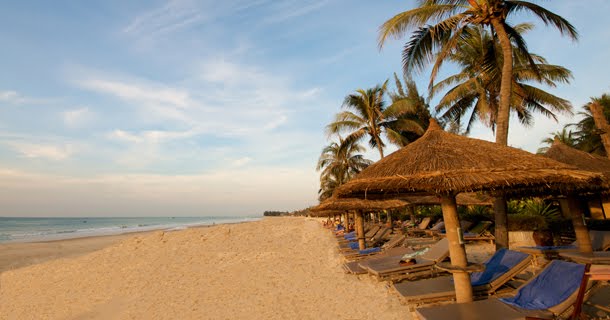
Visitors who now flock to this Cape land all have their own reasons. Many love it here as they can leisurely wander along endless palm-shaded roads and pristine sandy beach. Many others have their bath warmed up by the clear waves or freshened by the tropical breeze over the dunes around.

Many simply observe how the winds daily change the shape of flying-sand hills and do not reject a board slide down from dunes top. Many others like footing in the cool streams making ways through colorful canyons impressively formed by years of rains.

Many are pleased riding to visit centuries-old brick towers possessed by a bygone kingdom and share the surprise about how the ancients could build them up without using any kind of mortar. Many others are even ready for traveling further to trek up rock steps to the 49-m long reclining Buddhist statue, the largest in South-East Asia.

Many are seen contemplating the biggest collection of whale skeletons preserved downtown while many others cannot wait visiting fishing villages at the other end of the locality to recall how the families of the old days fished and lived. And many among them come for Bamboo Village.

RESTAURANT & BAR
Majestically stylish 180-seat beachfront Strawy Restaurant appears as a venue for diners who love meals seasoned by all the oceanic and botanic flavours, from buffet breaksfast delicacies to late evening snacks. Materials used like thatch, terra-cotta, earthen straw, wood and bamboo word the Resort’s adherence to the environmental concepts and commitments. International, Vietnamese and local cuisines serve guests, from whatever corners of the world, moments to enjoy and discover.

Southeme Restaurant – to honour on the culinary arts of South Vietnam and Fine Dining Room – specially designed for the demand of highly private, personalized and refined service, are actually exclusive modifications worth visiting anytime.

Upstairs East Cape Bar meaning also a real escape acquires an unusual outlook of lagoon splendours. Each among the long lists, either beer or soft drink, spirit or juice, either a coffee or a cocktail can bring guests under this 30-seat thatched roof up to carefree peaks.
Jolly beach bar helps surfers to immediately unwind and Cooking classes, scheduled or upon request, offer extra joys to diners. Pool-side, garden view Asparagus Coffee Lounge is to refresh and reenergize swimmers and conference attendants, providing minutes’ break or hours’ relaxation without having to make any step away.

MEETING FACILITIES & OTHERS
For the most convenience of your stay, the Resort provides free wifi access, parking lot, 24-hour security, lifeguards, and accommodations for guides and drivers of groups. The Resort cares also for needs of baby-sitting, airport transfer with private air-con vans, mailing, exchange, gift-shop, express tailoring, laundry, IDD fax and phone. Golf-links are also only in 2km reach.

Especially, for the delicate demands of the MICE segment, quality meeting facilities are offered. Organizers of formal events will find the over 100-seat carpeted Swannery Conference Room totally perfect with all the state-of-the-art audio-video and air-conditioning systems, all set-up availability, and garden-view coffee lounge within reach to offer so relaxed intervals. And the 40-head fully-equipped air-con Greenery Meeting Room is appropriate for traditional workshops and trainings with its pool/garden view assuring the attendants of exciting tea-times.
Various meeting packages are tailor-made for various requests.

Ultimate Meeting Packages inclusive:
Usage of meeting room from 8:00AM - 12:00AM and/or 1:00PM - 5:00PM
Registration desk with flower
Standard Meeting Set-up: Classroom style or U-shape style
OHP & LCD projectors
Micro phones and P.A system
Flipchart and white board with maker pens
Papers and pens
Bottled Purified Drinking Water per person
Mints
One coffee break (Tea, coffee, fruits and cookies) for each half-day

HOUSE PLEASURE
In the greenest, bluest, clearest and cleanest, adults will find attractions for their own while being sure that their kids also have a lovely playground especially designed for themselves.
Two pools offer swimming, sunbathing and reading leisure, different in forms but the same in extent of relaxation. Surf-lovers will get enough wind for their wavy feast while non-sportive persons will admire their sunny dreams flying up with the kites. Or simply the private beach - a sandy expansion of your well-being, the reachable Milky Way between the paradisiacal green and the ecstatic blue. The sea knows how to entertainingly excite human beings throughout the seasons.

And, library - a collection of books partly contributed by the guests who once stayed, popular table-tennis and snookers, selective fitness centre, etc. are all here for you not merely to kill your time but to fill it up with joys, on your own or sharing them with even ones met by chance for the first time.

Contact
Bamboo Village Beach Resort & Spa
38 Nguyen Dinh Chieu St., Ham Tien Ward, PhanThietCity,
Binh Thuan Province, Vietnam
Tel: (84) 62 3 847 007 Fax: (84) 62 3 847 095
Email: bamboovillageresort@hcm.vnn.vn
Web: http://www.bamboovillageresortvn.com/
Sales Office in Ho Chi Minh City
150 Phan Xich Long St., Ward 2, Phu Nhuan District, Ho Chi Minh City, Vietnam
Tel: (84) 8 3517 2788 Fax: (84) 8 3517 2789

Review


Jul 8, 2010

Romana Resort & Spa - Mui Ne - Phan Thiet

Welcome to Romana Resort & Spa, Mui Ne, Phan Thiet, Vietnam!

The only resort in Mui Ne where all rooms have ocean views and each villa has a private pool. From the reception area, you can capture a dramatic view of the deep blue sea and the soothing sound of the surf against the shoreline.The gentle touch of a fresh breeze and warm tropical weather give a sense of utmost peace and comfort. Upon entering Romana Resort & Spa, hustle and bustle of life and work become even farther away.


The Resort
Situated on a private mountain and surrounded by the sea, Romana Resort & Spa provides breathtaking vistas of the bay and mountain. The Resort offers 4 Junior Suites, 28 Villas with private pool and 64 Deluxe Rooms. All rooms face the ocean and are designed for privacy and luxurious relaxation. The Restaurants and Bars at Romana Resort & Spa are among the best in Mui Ne, Phan Thiet. For a memorable dining experience with magnificent sunset views, Panorama Restaurant is a showcase oceanfront dining venue. Panorama's à la carte menu features tantalizing appetizers, tropical salads, and a wide selection of fresh seafood.

Romana Resort & Spa’s leisure activities include many excursions and outdoor activities. At Oceania, the Sensual Luxe Spa, indulge in one of the innovative treatments to relax the body and soothe the soul. The Resort features a state-of-the-art conference hall. Whether you need a meeting for 300 guests or a 150-seat Deluxe VIP hall, Romana Resort & Spa can provide you with everything for a perfect event.

Meeting & Theme Dinners
Whether you are planning small meetings, executive meetings, intimate seminars and high profile events, Romana Resort & Spa provides the right blend of service, luxury and quiet efficiency.

The meeting rooms at Romana Resort & Spa offer you flexible places, and unlimited view of the sea. Whether you need a space for 300 guests or a 150-seat Deluxe VIP hall, we can customize our facilities to meet your individual needs and ensure a successful event. We are also delighted to help organize special theme evenings and group activities.

Whole Day Meeting Package US $40.00 per person
(Minimum 30 Persons)
Meeting room from 8:00 AM - 5:00 PM.
Standard meeting set-up.
Two mineral water and mints.
Morning tea and coffee break.
Vietnamese set lunch menu.
Afternoon tea and coffee break with pastries.
Free use of in-house audio/visual equipment subject to prior confirmation of availability.

Half Day Meeting Package US $30.00 per person
(Minimum 30 Persons).
Meeting room from 8:00 AM - 12:00 AM or 1:00 PM - 5:00 PM
Standard meeting set-up
One mineral water and mints.
Morning or afternoon tea and coffee break with pastriesVietnamese set lunch menu.
Free use of in-house audio/visual equipment subject to prior confirmation of availability

Incentive option
Theme Dinners: Vietnamese Night, Indochine Night, Chinese Night or Barbecue Beach Parties.
Team Building Activities: Tennis, Fun Sports, Swimming pool.
Group excursions to nearby of Phan Thiet Market, Mui Ne Sand Dune, Hon Rom Red

Canyon, Hon Rom Islet, The Fairy Stream,Phan Thiet water Tower, Cham Towers, Khe Ga Light house…

Terms and Conditions:
All the above rates are subject to 5% service charge and 10% VAT.
All rates are subject to change without prior notice.

Oceania Spa
Entering the reception area of Oceania, The Sensual Luxe Spa, is a soothing experience in itself. With the mysterious oriental architecture facing the ocean, a serene and truly unforgettable experience of pure pampering and relaxation is provided in exquisite surroundings.

The interiors are daubed in soft and natural lighting and furnished with both antique and contemporary pieces Imagine overlooking the blue ocean and listening to the soothing sounds of the surf while sipping gently brewed herbal tea. You will be guided through the extensive menu of Body, Mind and Soul by professionally trained staff.


For getting menu spa, please contact:
Romana Resort & Spa
Sales & Marketing Office, Ho Chi Minh City
92 Nam Ky Khoi Nghia Street, District 1
Tel: (84-8) 3914 4645/ 3914 2773
Email: sales@romanaresort.com.vn


Much has changed, but much has stayed the same as Hanoi’s famous old quarter weathers the storms of modernity.
Hanoi’s old quarter doesn’t seem so old.

Brand new motorbikes, SUVs and even busses zip by in every direction, shattering ear drums with their horns and pushing stray pedestrians out of the way.
But despite the traffic and modern signage, much of traditional Hanoi is the same as it was before the motorbikes and SUVs.
Peek through or above the thick black electric cables blocking your view overhead and you’ll see the colorful, if not fading, facades of old Chinese shophouses, French villas and Buddhist pagodas and temples.
Elderly couples sit and drink tea on their stoops, youngsters smoke cigarettes on balconies adorned with decorative iron work and trellises filled with tropical plants.
But each residence is also a business, turning the entire quarter into a giant market. Down the tiny streets and seemingly endless labyrinth of alleys, shopkeepers sell everything under the sun, from ball bearings and light bulbs to live chickens and snake wine. The clutter of open air fish markets, the noise of squealing pigs and the loud screeches and bangs from the metal workshops make this site unlike any in the world.
But the history of the area is shrouded in mystery, like the low fog that hangs over Hoan Kiem Lake on early winter mornings.
Many Vietnamese and foreigners know the area as the “36 streets” which is a misnomer, as the quarter has far more than 36 streets, and no one is certain where that number even came from.
Some researchers say the oldest part of Hanoi was originally based off of 36 streets, each of which sold a different ware. Others contend that the number 36 came from the 15th century, when workers of different trades gathered in different areas to form 36 “guilds,” or workshop areas, not actual streets.
Some attribute the number 36 to abstract numerology. The number nine signifies abundance in eastern philosophy. Nine times the four directions makes 36, which people take to mean "many," or “plenty.”
A district blossoms
Nowadays, the streets of the old quarter are still associated with traditional trades plied there for hundreds of years.
That’s why they’re called Hang (which means merchandise or shop), followed by the name of their product: therefore Hang Chieu (mat) sells mats, and Hang Bac (silver) traders specialize in silver and jewelry.
History books say that during the beginning of the Ly Dynasty (1010-1225), the streets now known as the old quarter began to branch out around the citadel. As King Ly Thai To had just moved the capital of Vietnam to Hanoi, people from all over Vietnam, and even China, Cambodia and the Kingdom of Champa began moving to the area for it’s commercial opportunity.
Among these were renowned silversmiths and blacksmiths from the northern Vietnamese province of Nam Dinh. They and other craftsmen and artisans began to ply their trades in Hanoi and workers making or selling similar goods set up shop on the same streets because most of them were usually from the same hometown or region.
In the early 16th century, the old town area became the production and trade center of Thang Long (now Hanoi), and people first began referring to the “36 streets.”
The craftspeople of the old quarter then formed artisan guilds and named the streets, which might not have been actually streets before this period, for the trades practices and specialties sold on them.
In fact, each “Hang” is not merely a street, but more like a miniature trading village all in its own.
Traditions live
There are now around 30 streets that still keep the name “Hang,” compared to over 50 a century ago.
But some no longer trade the products related to their name, like Hang Than (coal), which now sells wedding teas and cakes. Hang Buom (sail), Hang Voi (lime), Hang Be (raft) no long trade in the bulky goods they were named after.
Hang Be is a special case as it used to be right on the shore of the Red River. But the banks have receded over time and it became inconvenient to trade rafts in the middle of the city.
Locals have also changed the names of several streets that no longer trade in the products associated with their names hundreds of years ago.
The traditional shops on Hang Son (which sold varnish and paint) and Hang Bat Dan (glazed terracotta ware), have been replaced by cha ca (fried fish patties) shops and pho (beef noodle soup) stalls, and Hang Son is now Pho Cha Ca.
Hang Chao (rice porridge) now shares a street with hundreds of shops selling screw and electrical appliances, whereas Hang Dieu (tobacco water pipe) now specializes in blankets, pillows, and cushions. Hang Mam (salted fish) no longer sells mam.
Hang Non (hat), Hang Luoc (comb), and Hang Ca (fish) streets have now been gentrified and are full of boutiques selling luxurious goods. Hang Gai specializes in selling expensive silk to foreigners.
But the poorer days of Hanoi can still be seen in many of the old quarters small streets. Hang Bun (small rice noodles), whose original name was Hang Mun (scraps), was where locals collected bits of cloth to mend ragged clothes. Hang Chai (scrap metal) was a scrap-iron dealer hub, but the street is now a headquarters for dragon dancers and a dao (traditional Vietnamese chamber music, sometimes compared to Geisha entertainment) singers.
Neo Retro
Many traditional streets continue to shine through, withstanding the onslaughts of change and urbanization around them.
Many locals still prefer shopping on several streets that have barely changed. Hang Bac (silver) and Hang Khay (products inlayed with mother-of pearl) are still popular even though shoppers have many more newer, more modern options throughout the city.
During the mid autumn festival, Hang Ma (shiny paper products, such as gift wrappings, wedding decorations and miniature paper objects to burn for the dead) still lights up the way it did centuries ago with parents taking their children to buy toys or lanterns.
Hang Dao is still the city’s most popular clothing stop for women. The first shop owners there were skillful tailors from villages surrounding Hanoi. So when they eventually named the street running through the area, it became Hang “Dao”, which means “flower” or “beautiful woman”, in reference to bright clothes and the ladies who bought them.
Hanoians still believe they can tell a person’s character based on which area of the old quarter they come from. Men from Hang Bac are considered polite and elegant, while women from Hang Dao are known for being charming and gorgeous.
For now, the old quarter is still elegant, charming and gorgeous, even if the motorbikes aren’t.

A guilded, gilded future beckons ...

If stakeholders prevent the promotion of craft villages from descending into crass commercialization

One of the most alluring, enduing aspects of Hanoi, for both visitor and resident, is the Old Quarter – a network of 36 guild streets that flourished centuries ago, and are flourishing today, retaining a lot of their original charm.

Now plans are afoot to highlight the attractiveness of guild villages, which are a traditional feature of Vietnam, particularly concentrated in and around Hanoi.

As the capital city prepares to celebrate its 1,000th anniversary, five traditional craft villages within the municipality are being surveyed to be built up as tourist destinations for a “Hanoi Traditional Craft Villages Tour.”

By reputation, these villages practically select themselves.

Bat Trang ceramics, Van Phuc silk, Phu Vinh rattan and bamboo, Ha Thai lacquer and Chuon Ngo Mother of Pearl are all famous products of the capital city, which have made these villages’ names well known for hundreds of years.

The reputation has, of course, been economically beneficial for residents and craftsmen and craftswomen of the village.

Unfortunately, the same cannot be said of most of the 256 craft villages in the capital city that are mired in all sorts of difficulties and need serious support in order to preserve and develop their traditional crafts.

The Hanoi Craft Villages Tour program is expected to address their problems.

The tour is part of the second “Hanoi Craft Week, held from August 4 to 9 by the city’s Department of Industry and Trade.

According to information carried on its website (www.hanoicrafiweek.com) the tour will be designed and organized by experienced travel experts and famous craftsmen, and will offer practical experience with the crafts apart from sightseeing beautiful, historical sites in the vicinity.

Luu Tien Long, director of Hanoi Department of Industry and Trade and also director of the exhibition organizing board, said the five villages chosen met all the criteria including history, location, occupation of residents and expressing the “quintessence of Hanoi”.

Hub of traditional crafts

After the erstwhile Ha Tay Province was merged into Hanoi, the capital city has become “the land of a hundred traditional crafts” about one fourth of which are more than 100 years old.

In fact, work to exploit the potential for tourism development in the traditional craft villages began almost 10 years ago, but has not made much headway.

Apart from the big names like Bat Trang and Van Phuc, many villages still remain unknown.

Local authorities have identified different problems and acted on them, but to no avail. They have blamed the situation on inconvenient location or poor infrastructure and invested more in upgrading roads, building exhibition houses and setting up shops.

At the Phu Nghia Rattan and Bamboo Village in Chuong My District, money was invested in an exhibition center, but only 30 foreign visitors have been to it over the last eight years. Many other villages are conveniently located on the way to famous spots like the Huong Pagoda, Duong Lam Ancient Village and the Ba Vi National Park, but there are still very few visitors.

Bui Thi Linh, owner of a workshop producing hats in Chuong Hat Village, Thanh Oai District, says improper investment is an obstacle to tourism development. “It usually takes too much time to carry out a project,” said Linh. “For example, the trade center in our village has not been completed after almost ten years, and no one knows when it will be finished. Besides, we are not instructed on how to provide tourism services properly.”

Sarah, a tourist from Australia, had just returned from the Ha Thai Lacquer Village in Thuong Tin District.

“After reading an article about Ha Thai, two of my friends and I decided to discover it on our own on motorbikes. The artisans in this beautiful village were doing great work but to our disappointment, there was nobody who could help us understand more about their products.

“They live very close to the capital and there is great potential for developing tourism but there was no local guide and it was difficult to find anybody who could speak English,” she said.

Marianne from England followed a tour to the Quat Dong Embroidery Village last month and did not have a better experience. She was rather annoyed when asked to buy an embroidered handkerchief at the village at a very high price.

Luong Thu Hoai, a tour guide with the NTT Travel Company, said many local artisans charge very high prices for their products from foreign visitors.

“They do not deal with foreign tourists frequently, so they do not understand these customers,” Hoai said. “I usually advice the local villagers not to do it but many of them just want to fish in troubled waters.”

However, Hoai reserved praise for the Bat Trang and Van Phuc villages for their “sharp mind” in dealing with the modern tourism market. “The artisans in Bat Trang Village have introduced many new products to attract visitors like the buffalo cart ride or the “Play with Clay” service which has visitors make their own products under instructions from artisans.”

Nguyen Van Hung, chairman of Van Phuc Silk Collective, said the village receives some 100,000 visitors every year. “Visitors make up 30 percent of our customers,” he said, adding cooperation between travel companies and artisans made this success possible.

Travel agents should also share some responsibility for the lack of tourism development in Hanoi’s craft villages. Many visitors have criticized local travel companies for their repetitive itineraries and poor products.

Bare necessities

The experiences of tourists in Hanoi and elsewhere in the country make clear some of the basic necessities to make tourism succeed and be sustainable, experts say.

There is a clear need for good guides who are fluent in English and also well informed about the history and cultural traditions of a place. Tourism must be perceived as a long-term benefit, and the temptation to sell substandard products at high prices should be resisted firmly as the villages’ reputation is at stake.

The tendency to set up similar “modern” facilities everywhere, like exhibition centers, or hotels, end up destroying the traditional, unique charm of a village. This should be a avoided at all costs, because visitors have already complained about the excessive commercialization and monotony of many tourist spots in the country.

If they do not find genuinely unspoilt places, visitors will stop treating Vietnam as a serious destination. And Hanoi’s craft villages will cease to be a tradition that the capital city can take pride in.
Ba Na Mountain in the central city of Da Nang offers more than an escape from the summer heat
Ba Na’s recent claim to fame is two entries in the Guinness Book of World Records, for the longest (5,042m - 16,545ft) and highest non-stop cable car system (1291.81m - 4,239ft above sea level), but what lingers in the mind is not the technological feat, but a sense of rediscovery.

Located in the Truong Son mountain range, Ba Na in Hoa Vang District was “discovered” in 1901 by the French colonialists with their predilection for building high quality resorts to pamper high ranking civil servants and military officials.

The temperate climate, unspoiled forest, and spectacular views of the sea and mountains made it an irresistible location, and many French officers chose to build their own villas here. Historical documents show Ba Na, 46 kilometers southwest of Da Nang, soon became a French town with a main road to the mountain peak, private houses and villas. By the late 1940s there were several hotels, a stadium, a market, a medical station, an opera house, security and police stations, and not to mention more than 200 private villas.

After the 1945 August Revolution forced the French to withdraw from Vietnam, Ba Na was relegated to relative obscurity as Vietnam became embroiled in a long struggle for freedom against the French and the Americans.

Ba Na today

Considering that there is still just the single, long winding road that requires strong engines and brave minds, not to mention hours of patience, the cable car system seems a boon. It carries visitors from the foot to the top of the mountain in about 20 minutes, and as befits the world record holder, it offers breathtaking views of the lush jungle and waterfalls along the way.

Watching the Ba Na Mountains from high above is an experience in itself, but there is more to offer. Newly-built French-style hotels including Hoang Gia, Le Nim, or Morin offer super comfortable accommodation, and there are trekking tours to explore the mountain.

Specifically, five routes designed for tourists wind their way through thick forests, springs and waterfalls, and many vestiges of French colonial constructions.

After checking into the Morin Hotel that afternoon, we followed a short trail from the Ba Na By Night Resort to explore the forest, ancient mansions and listen to the laughing thrush. Sport shoes, some leech repellant and raincoats were strongly advised.

“In summer, Ba Na has four seasons in a single day,” Hue, a young guide, told us. “In the afternoon, the weather is like autumn and it may rain at any time.”

The sun was still bright, but the dense forest made the only narrow path dark very quickly, and our steps quickened without any further prompting. At some parts along the way, however, the sun suddenly appeared through the leafy canopy, as though the scenery was playing peek-a-boo.

The old fir trees and ferns that were several dozen meters tall evoked awe as only nature can.

Some mossy terraces led us to the vestiges of old French mansions, also covered with moss. We easily conquered the 800m trail in about 30 minutes and were rewarded by the beautiful sight of Ba Na By Night Resort with its Meditation Garden, the Lavande Hotel, and many small paths covered with colorful flowers.

Our guide told us that the graceful ball-like flower, hydrangea, or cam tu cau in Vietnamese, which was all over the place, was often referred to as a symbol of Ba Na.

Hue whetted our appetite for the place further. Tomorrow, she said, she would take us on the longer trail (3km) to the Thung lung Vang (Golden Valley).

“You will see vestiges of some old gold mines and learn about the lives of miners who worked there decades ago,” she said. “You will see beautiful natural scenery with waterfalls, flowers, and creeks. Let’s return and prepare for tomorrow.”

We couldn’t wait.

For more information on tours or accommodation on Ba Na, contact Ba Na Hills Resort, An Son Hamlet, Hoa Ninh Ward, Hoa Vang District, Da Nang City, tel: (0511) 379 1999 or 379 1791, email: rsvn@banahills.com.vn, website: www.banahills.com.vn

Annual Fruit Festival 2010: Suoi Tien constantly renews

Nowadays, besides the long trips, Vietnamese and foreigner are fond of entertainment type of short trip which typically is Suoi Tien Cultural Theme Park. Diversification of both entertainment and cuture, it attracts a flock of visitors of all ages come here by the land of water-filled fantasy, far away from 15 kilometres South of Ho Chi Minh City.

Suoi Tien, or "the fairy stream," is the world's first water park indoctrinated to Buddhism, specifically its Southeast Asian animistic form, is built in January 2000. It is very favorably impressed by the Dragon, Unicorn, Tortoise, and Phoenix as its sacred animals, used thematically throughout the massive water park. One of the basic tenets of the Buddhistic faith is shown by the law of causality in some special games with purposes to help people who manage to escape the torments of hell after becoming addicted to drugs, alcohol, lust.

In addition, The park has several entertainment areas. The landscapes and attractions in the park imitate the Vietnam's History and legends through the image of the great creator Au Co (the mother of Vietnamese civilization) and Lac Long Quan (the father of the Vietnamese people) as well as the Battle of Son Tinh (Mountain Genie) and Thuy Tinh (Aquatic Genie), visitor might also enjoy a swan or turtle-shaped boat ride around the island pavilions, take part in many hilarious games and funny activities there.

Making every effort to lead new understandings on the interactions, Suoi Tien always give facilities of having occasion of great festivities like The Annual Fruit Festival as an instance. The Southern Fruit Festival 2010 took place from June 1 until June 19 with activities such as decorative fruit arrangements, impressive fruit sculptures, funny fruit-eating contests, exciting fruit games, as well as fruit seminars and new fruit introductions.

"This year's festival was much more interesting with boats and peasants that were all put on in traditional southern outfits to evoke images of the famous floating markets in the Mekong Delta area”. Especially, there was a parade of The Monkey King (Sun Wukong in Flower-Fruit Mountain), the main character in the classical Chinese epic novel “Journey to the West” and 16 fruit genies incarnated the life of prosperity and longevity.

A total of around 4 billion VND approximately $210,500 USD expended on the activities during the festival. It was estimated that of these, 25% was higher than in 2009. A contest was held to speak highly of farmers and artisans who had fresheness and good-quality tropical fruits and works of hand-made art from them. Pham Thiet Hoa, Director of the city's Centre for Agricultural Consultancy and Support, ever said.

"The first contest held last year, already attracted 214 contestants. We had expected to increase around 350 in this year but had reallly received up 458 candidates." she said

The Annual Fruit Festival including lot of funny activities in Suoi Tien, it is given useful information about the special event. It assists smoother workflow and distribution planning where negotiate better terms with suppliers both nation-wide with world-wide. Especially, the park becomes an ideal place to fit group of targeted prospects where the locals and foreigners, international travellers enjoy their holidays and out-door activities.

HCMC makes list of heritage sites

The HCMC Department of Culture, Sports and Tourism has completed an inventory of historical-cultural relics in the city that it plans to recommend for recognition as national and city-level relics.

Dr Pham Huu My, Director of the department's Centre for Preservation and Development of Historic-Cultural Values of Relics, which did the task as part of a five-year programme on the city's historical-cultural values of relics, said there are 83 sites in the list. Of them, a historic relic and seven art architectural relics will be proposed for recognition as national relics, he said.

"The inventory and recommendation will play a key role in the preservation and development of historical-cultural relics in the city because with recognition they will get legal and scientific support," he said.

Also under the project, the 140 existing national and city-level relics were carefully studied for encroachment and degradation so that measures can be taken to stop them.

Nearly 30 are proposed to be restored at an estimated cost of VND353.5 billion (USD18.6 million), most of them architectural relics dating back hundreds of years.

The department will submit its recommendations to the city People's Committee for recognition as national or city-level relics, Vu Kim Anh, Deputy Director of the department, said.

"The outcome of the project will be a key factor in drawing up the 2010-20 zoning plan for preservation and development of relics in the city," Anh said. The city's existing relics include one special national relic, the Reunification Palace , and 53 national relics.

Painting display raises fund for the poor


As many as 71 “thuy mac” (ink-and-wash) paintings on Vietnam’s land and people are on display in Hanoi to celebrate the capital’s millennium anniversary and raise fund for the poor.

Through his paintings, painter Truong Han Minh depicts the beloved country, landscapes, villages, Hanoi capital city with interesting places. He also shows ink-and-wash paintings illustrating Uncle Ho’s poems.

Painter Truong Han Minh was born in 1951. His works were exhibited for more than 50 times in the country and overseas such as in Malaysia, France, the United States, China, Japan, Australia and Laos.

The exhibition lasts till 13 at the Vietnam Fine Art Museum at 66 Nguyen Thai Hoc Street. Painter Truong Han Minh will donate half of money from the exhibition to the Vietnam Fatherland Front’s Fund for the Poor.

The ink-and-wash technique of painting originated from China in which both watercolour and tempera are used to create the desired effect.

Thousands of objects belonging to Sa Huynh culture that dated from 2,500-3,000 years ago have been discovered during excavations carried out in the Ma Vuong Mound in Pho Thach Commune, Duc Pho District, Quang Ngai Province from June 17-July 4 this year.

Head of the archaeologists’ group Doan Ngoc Khoi said that his group also found porcelain Linga among earthen ports, vases and bowls and other porcelain and stone artefacts.

This is the second time porcelain Linga statue has been found in the Ma Vuong Mound with the first being in 1978, he added.

Excavation of an ancient Cham Tower which was discovered for the first time in Krong Nang Commune, Krong Pa District of the Central Highlands province of Gia Lai , was conducted in late June this year.

Different from other Cham towers, Bang Keng tower has a semi-submerge brick design which is 6.4m x 7.8m and has a 1.8m foundation.

1,000 cultivated bamboo dragons as a symbol of Hanoi-Ascending Dragon Millennium

Nguyen Van Nam, the craftsman pilot located in Hoa Binh province who has yet to be used bamboo primarily as a supplemental and decorative element in building such as fencing, planks and sheets, largely due to the ready abundance of quality perennial evergreen. In 1998, he became famous for forming a tree to a line of words “Bac Ho Vi Dai” (The Great Uncle Ho), and now it is continuously shown off into the HoChiMinh mausoleum.

On this occasion of Hanoi-Ascending Dragon millennium anniversary that will be hold in October, 2010, he creates and is supported from an 1,000 bamboo trees by forcing their growth with the desired form of 1,000 dragons.

As he get started to this project, various kind of green bamboo is harder to train as it grows. He finds out only golden bamboo is easy to compress the growing stalk within square form. The golden bamboo is much grown in Soc Son district where Vietnamese legendary hero Saint Giong – who was 03 year old had grown up immediately and magically pullling of this kind of bamboo trees to fight against An invaders.

“This sort of bamboo is very flexible, not as hard as green bamboos, thus making it easy to create multi-shapes as expectation,” he explained.

Be aware that the 1000th Hanoi-Ascending Dragon ceremony is in great value of being started into launch, he have co-worked this project with other landowners since 1998. All
2,000 bamboo trees are used as an ecological construction material. They are selected to shape by training them to assume within a square dragon form with a height of 1.5 meter. He is now working on the culm to curve sprout branches and leaves from each node daily.

Bamboo's long life has made it a Vietnamese symbol of longevity so far. And now, the works of Nguyen Van Nam really symbolizes the spirit of the Vietnam nation and Vietnamese value will be maintained and developed eternally.